Halogenation of α-Mangostin: Synthesis, Characterization, and Molecular Docking Study Against EGFR Tyrosine Kinase
Keywords:
α-mangostin derivatives, anticancer, EGFR inhibitor, halogenation, molecular docking.Abstract
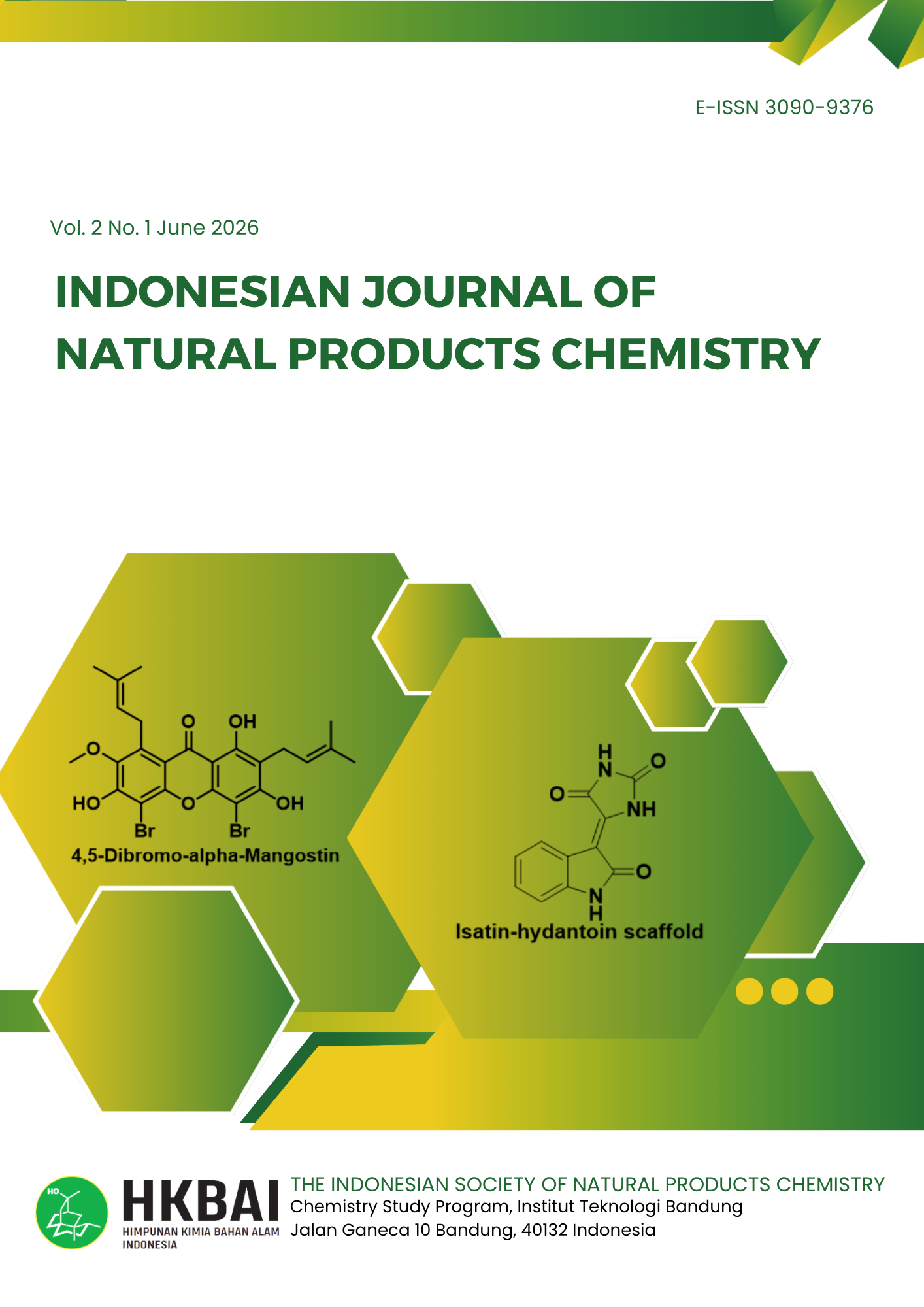
Epidermal growth factor receptor (EGFR) is a key target in cancer therapy because it promotes tumor cell proliferation and survival. α-Mangostin (1), a major xanthone isolated from Garcinia mangostana, has attracted considerable attention owing to its diverse pharmacological properties, including anticancer activity. Previous studies have demonstrated that structural modifications of α-mangostin can enhance its biopharmacological potential. In this study, three halogenated α-mangostin analogs, 4-chloro-α-mangostin (2), 4,5-dibromo-α-mangostin (3b), and 4-bromo-α-mangostin (3b), were synthesized via an environmentally benign halogenation approach under mild reaction conditions, minimizing hazardous reagents. All compounds were successfully characterized using NMR spectroscopy. Molecular docking study against the EGFR tyrosine kinase domain revealed that compounds 2-3b exhibited favorable binding affinities, with binding free energies of -8.63, -9.02, and -8.96 kcal/mol, respectively, which were lower than those of erlotinib as a positive control (-7.89 kcal/mol). These results suggest that halogenated α-mangostin analogs are promising candidates as EGFR tyrosine kinase inhibitors and warrant further evaluation through in vitro enzymatic inhibition assays and cytotoxicity studies on cancer cell lines.
Downloads
Published
How to Cite
Issue
Section
License
Copyright (c) 2026 Indonesian Journal of Natural Products Chemistry

This work is licensed under a Creative Commons Attribution-ShareAlike 4.0 International License.